


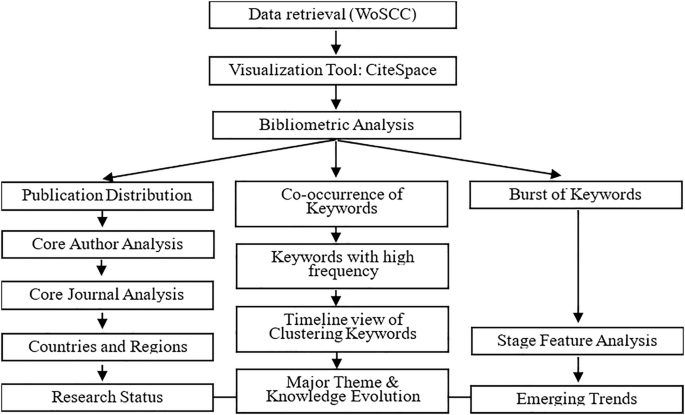
This section reports the visualized analyses of research on the integration development of information technology into foreign language teaching, including publication year distribution, keyword co-occurrence, author, journal, timeline view, keyword burst, country, and region.
Distribution of publication year
Figure 2 shows the number of papers published in the WoSCC concerning the integration of information technology into foreign language teaching (2000–2024). From the distribution of publication years, it is seen that there is a clear distinction in the number of publications, showing a trend of rapid development and gradual stability, which can be roughly divided into three stages: 2000–2005, 2006–2019, and 2020–2024. During the initial stage (2000–2005), the annual publication count was relatively low and was always below the average of 10 articles per year. The period from 2006 to 2019 was characterized by rapid growth, during which the number of publications increased every year, except for a slight decline in 2016. The final stage (2020–2024) was characterized by the trend of stable development, with an average of approximately 446 publications per year.


The figure, which denotes the number of published papers on IT and FLT, is constructed by a curve chart.
Co-occurrence analysis of high-frequency keywords
Keywords are the core representation of articles and research topics. Keywords co-occurrence analysis is used to reveal the research frontiers and hotspots in a certain domain (Wang and Lu 2020). The parameter settings for the keyword co-occurrence analysis were set to their default values, with the time range spanning from 2000 to 2024, and the nodes represented by the keywords. As shown in Fig. 3, each node represents a keyword, and the size of node represents the frequency of keyword occurrence. The larger the node, the higher the frequency of keyword occurrence (Chen 2006). The nodes “language” and “technology” are the core keywords with two purple rings on the periphery, which indicates a greater number of citations in literature. The nodes “English”, “students” and “education” are also relatively large, exceeding the nodes of most keywords, followed by hot keywords such as “foreign language”, “learners”, “model”, “performance”, “impact”, “online”, “perception” and “motivation”. To gain a better understanding of the keywords above, the values of centrality are computed to identify the keywords that play a central role between two or more articles (Pinto et al. 2009). As shown in Table 1, although the frequency of some keywords such as “learners” and “performance” is high, the centrality values of these keywords are relatively low, only 0.04, which means that they do not have the same intermediating function as other keywords including “knowledge (0.06)”, “instruction (0.06)” and “attitude (0.06)”, etc. Nevertheless, the emergence of the two keywords “learners” and “students” reveals that the integration of information into foreign language teaching is undergoing a paradigm shift, moving from a teacher-centered to a learner-centered approach. This transformation has been facilitated by the rise of multimodal teaching, which leverages various forms of media and technology to create richer, more diverse learning environments. As emphasized by Vanderplank (2010), an effective paradigm for language teaching lies in employing technology to promote social interaction rather than individual student control, monitoring, and repeated practice of their own performances. It is worth noting that central to this shift is the concept of personalization, where instructional methods are increasingly tailored to meet the individual needs, interests, and learning styles of students. Meanwhile, experiential learning has emerged as a critical component of this new paradigm, emphasizing the importance of real-world language practice. By integrating technology into authentic learning experiences, students are encouraged to apply language skills in meaningful contexts, thus promoting both cognitive and affective development.


The figure denotes the keywords co-occurrence network based on the integration research of IT into FLT (2000-2024).
Author co–citation analysis in the integration research
The analysis of author co–citation can be used to find the core authors in the integration research of information into foreign language teaching. The parameter settings are the same as those in the analysis of keyword co-occurrence, except that the node type is “author”. Figure 4 shows that the author with the highest number of citations is Warschauer, M. (211), an American distinguished professor in informatics and language science, who has 11 papers with more than 100 citations. For instance, in the paper “New technology and digital world: Analyzing evidence of equity in access, use, and outcomes”, Warchauer and Matuchniak (2010) acknowledge the significant advantages of technology in enhancing the quality of foreign language teaching, but also highlights the associated inequalities, based on access to resources and digital literacy. Other core authors that have also contributed greatly to this research domain include Ellis, R. (166), Godwin-Jones, R. (150), Dörnyei, Z. (140), Davis, F. D. (140), Levy, M. (131), Prensky, M. (128), Creswell, J. W. (120), Kukulska-Hulme, A. (116), Lai, C. (108), Vygotsky, L. (103), and Golonka, E. M. (100), etc., whose research fields involve linguistics, educational technology, foreign language teaching, and psycholinguistics. Geographically speaking, these core authors mainly come from countries in the Americas, Europe, and Oceania, showing the rich innovative achievements of these countries in this research field. Notably, some of these authors’ papers concerning language teaching technology and mobile language learning, rank high in the reference analysis, which to some extent reflects their core competencies and rich contributions in this research domain (see Table 2). For example, the article “Technologies for foreign language learning: a review of technology types and their effectiveness” by Golonka, E. M. et al. rank first, with a co–citation count of 80 times and a single citation count of 484 times, implying that this article has a great effect on other studies in this domain.


The figure denotes the network of author co-citation in the integration of IT into FLT (2000-2024).
Analysis of citated journals
The analysis of citated journals is performed to find the core journals that have published many research papers in this field, with a relatively high citation frequency. Table 3 clearly shows the top ten journals with the highest citation counts, which are mainly concentrated in two regions, the USA and England. The journal “Computers & Education” with 926 citations ranks first, followed by Computer–assisted Language Learning (841), Language Learning & Technology (749), System (679), Modern Language Journal (612), British Journal of Educational Technology (558), and ReCALL (542). Most of these journals are classified as technology-related journals, which connected to computer technology. Table 3 clearly shows that the key educational technology journals in England and the USA play a leading role in the integration research of information technology research into foreign language teaching.
Analysis of countries and regions
An analysis of countries and regions contributing to this research field has been conducted. In the parameter settings, the node type is “country” and the other parameters are the same as those in the previous two mapping pictures. The node size indicates the extent to which the country is conducting research in this field. The larger the node is, the richer the research. Figure 5 shows that the relatively large nodes are Russia, the People’s Republic of China, and the USA, followed by Spain, Taiwan, England, Ukraine, Germany, and Turkey, among which the distribution of countries and regions with rich research results in this field is relatively even worldwide. Although the size of node such as Ukraine, Turkey, and Taiwan, is larger than that of most other countries and regions, it does not have the purple ring on the periphery, which indicates that the centrality values of literature related to the research in this field are low and that these documents have not been cited extensively.


The figure denotes the network of countries and regions that contributed more to the integration research of IT into FLT (2000-2024).
Timeline view of the integration research
The timeline view in CiteSpace can reflect the evolution of keywords and their impact on other keywords. In this analysis, the parameter settings are the same as those in the keyword co-occurrence analysis. Figure 6 shows the timeline view of keywords related to the integration research from 2020 to 2024, with 9 clusters of keywords including “learners”, “anxiety”, “user acceptance”, “education”, “tool”, “technology”, “language”, classroom, and “instruction”. The network of clustering keywords involves most of the teaching elements such as teachers, students, teaching tools, and instructional methods, suggesting that the research results in this field are rich and comprehensive. As shown in Fig. 6, except the two clustering keywords (#1 learners, #2 user acceptance, and #4 tool), the other six clustering words all appeared during the process of integration development, and had little impact on other keywords because of the presence of larger nodes on their timelines. Moreover, the beginning emergence of keywords such as “students”, “technology”, “language” and “English” also had a great impact on subsequent research. During the process of the integration development, the emerging themes like “model”, “impact”, and “design” indicate a growing emphasis on evaluating the effectiveness of technology-enhanced learning environments. Psychological aspects such as “anxiety”, “motivation”, and “user acceptance” have also gained prominence, addressing how learners adapt to and benefit from new technologies. In recent years, generative artificial intelligence (AI) technologies, particularly large language models (LLMs) like ChatGPT, are revolutionizing foreign language teaching by offering personalized, real-time feedback and dynamic learning experiences (Mohamed 2024). These models can simulate real-world conversations, enabling students to practice speaking and comprehension in a low-pressure environment, which helps reduce psychological anxiety and enhance learning motivation and confidence.


The figure denotes the timeline of clustering keywords in the integration research (2000-2024).
Keyword burst of the integration research
The analysis of keyword burst focuses on abrupt changes in keyword frequence over time, which is beneficial for providing valuable insights for future research (Diao et al. 2022). The parameter settings are the same as those in the keyword co-occurrence analysis. Figure 7 displays the top 11 burst keywords. “Year” denotes the first occurrence of keywords, whereas “Strength” represents the bust strength value. “Begin” and “End” means the start and end years of the bust period respectively. The red bar visualizes the duration of the bust keywords. The keyword with the highest strength is “foreign language (5.91)”, indicating heated academic attention to foreign language teaching and learning. The keyword “comprehension”, which started to burst in 2000, had the longest duration until 2015, implying its continued impact on later research. It is worth noting that the keyword “integration” has been a hotspot since 2018, with the strength value of 4.56. Moreover, the keywords related to technology such as CALL (4.46) and MALL (4.23), are receiving more attention from academia. The other bursting keywords also reflects the changes in the research field of foreign language teaching research, such as form (4.14), acquisition (3.44), attention (4.7), design (3.55), text (3.51), and trends (3.42).


The figure denotes the top 12 keywords with the strongest citation bursts from the integrated research (2000-2024).
Computer-Assisted Language Learning (CALL), having undergone the stages of Behavioristic CALL and Communicative CALL, entered the era of Integrative CALL in the 21st century, facilitated by the advancement of internet technologies. During this period, the Technological Pedagogical Content Knowledge (TPACK) theoretical framework, proposed by American scholars Mishra and Koehler, significantly facilitated comprehensive reforms in foreign language teaching, particularly in instructional design, resource selection, and assessment methods (Mishra and Koehler 2006; Wang 2022). Notably, Canadian scholar George Siemens introduced the theory of Connectivism in 2005, which provided a theoretical foundation for Mobile-Assisted Language Learning (MALL). This theory posits that learning is no longer an internal, isolated activity confined to the individual, but rather a process of forming and navigating social knowledge networks (Shrivasta 2018). In the context of foreign language teaching, Connectivism highlights the importance of personalized learning experiences that are shaped by a learner’s interactions within a diverse network of linguistic, cultural, and technological resources.
link