


Sam Altman, CEO of OpenAI, takes his seat before a meeting of the White House Task Force on Artificial Intelligence Education in the East Room of the White House, on Sept. 4, 2025, in Washington. A recent survey by the Austin AI Alliance found workers are increasingly concerned about how AI will affect jobs.
Today, artificial intelligence seems inescapable.


It dominates headlines, drives stock swings for major companies and permeates our personal devices. It is present in email platforms, social media, Google searches and countless other digital tools.
Article continues below this ad
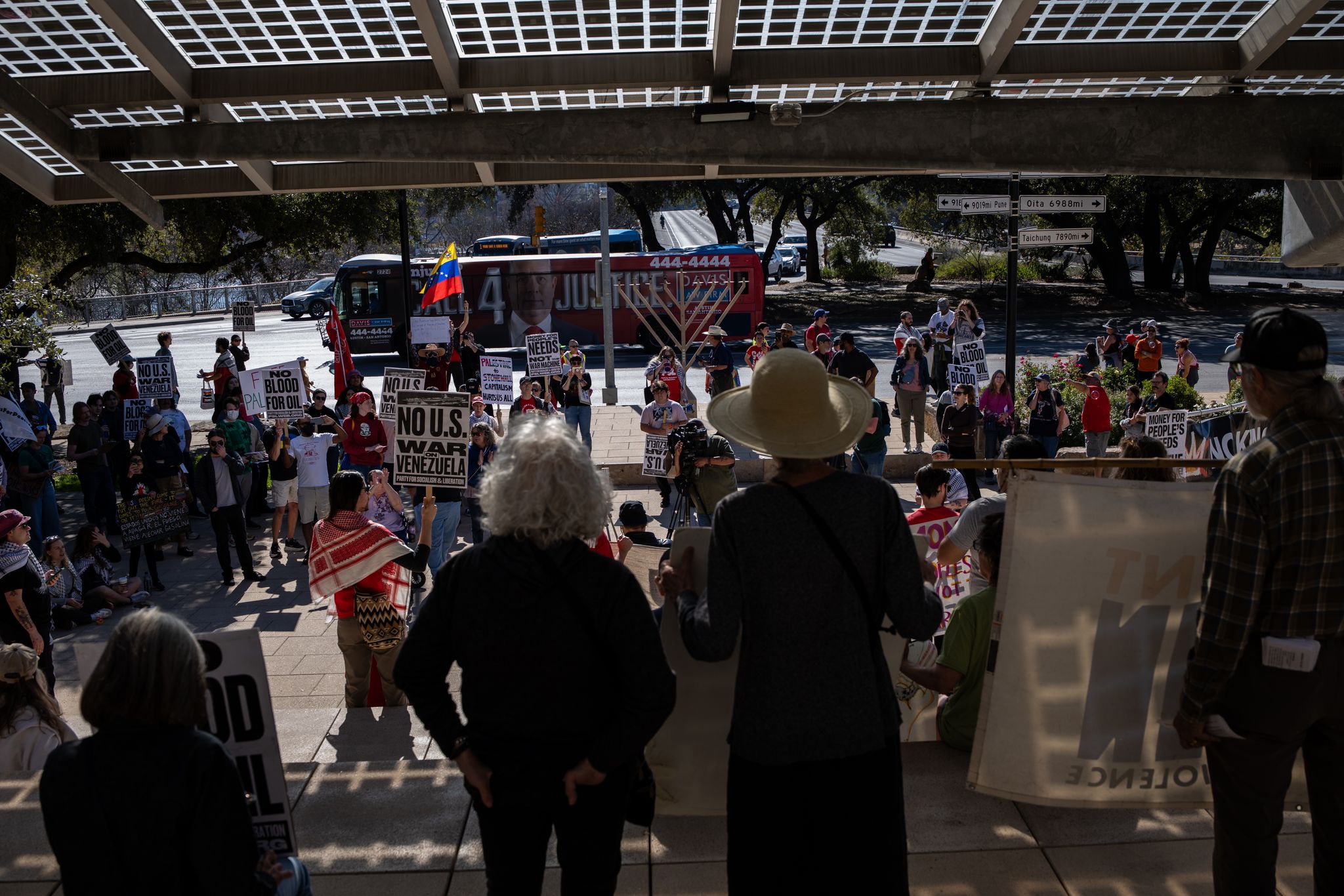
Dozens gather in protest of US intervention in Venezuela at City Hall in Austin on Jan. 04, 2026. (Kaylee Greenlee/Contributor)
Kaylee GreenleeWorkers around the world, including in Austin, are increasingly worried about what it means for the future of the workforce.
Last year, the Austin AI Alliance set out to better understand those concerns by surveying working-age Austinites.
Survey respondents said AI was a blessing because:
- 59% because of 24/7 availability.
- 53% because of accessibility.
- 48% because of automation of repetitive tasks.
- 44% because of creativity support.
- 38% because of medical breakthroughs.
- 27% because of potential to solve global issues.
Survey respondents said AI was a curse because:
- 67% because of loss of human touch.
- 63% because of deepfakes and misinformation.
- 61% because of job displacement.
- 58% because of loss of privacy.
- 52% because of weaponization.
- 44% because of addiction and dependence.
- 36% because of environmental impacts.
- 33% because of economic inequality.
The results suggest that, much like the widespread adoption of the internet, workers are increasingly concerned about how the new technology will affect jobs. The survey found that 53% said their workplace regularly used AI.
Article continues below this ad
About 29% of respondents said they were concerned about job displacement or changing roles due to AI in 2025. That figure rose to 38% when respondents were asked about 2026.
Even among those who said they had not yet felt those effects, 61% described AI as a curse because of job displacement concerns. About 45% cited fears of a potential unemployment crisis.
The group released the results of the survey at its annual State of AI event in January.
Article continues below this ad
“We know that AI is going to have a tsunami of impact on the way we work and on the nature of jobs,” said Larry Peterson, executive director of the Texas Foundation for Innovative Communities. “So how fast will this happen? It certainly will be accelerating. But no one knows the actual magnitude, in what we work on and how our job roles are defined versus actual jobs being fully eliminated.”
The alliance, formed in late 2024, was created to bring together major stakeholders in Austin’s AI world — from large technology companies such as Dell Technologies Inc. and AMD to startups and educational institutions — to support development, adoption and responsible use.
During the event, Marta Vieira Gattis, Indeed’s vice president of people strategy and operations, said the company’s studies suggest job skills and dynamics have changed significantly, but widespread job elimination has not occurred at the pace some fear.
The areas where AI could lead to significant job displacement or change are likely entry-level positions or roles where work traditionally done by several people could be reduced to one because of AI. Gatis cited accounting as an example of an industry that could face those types of reductions.
Article continues below this ad
“The people talking about AI are privileged,” Annie Hardy, an AI architect at Cisco in Austin, said during the event. “We are not hourly employees. We are not struggling. We are not at food banks. We are usually pretty well educated. We have resources, we have connections, we have networks. But when we talk about the jobs that are lost, and we talk about bookkeepers, or accountants, or customer service agents, a lot of these jobs that people are able to support their families with and make a good living doing, those are now going to be taken over by AI.”
While the biggest takeaways from the survey focused primarily on job security concerns, many respondents were regularly using AI and saw it as beneficial.
Roughly 38% of respondents said AI increased productivity at work in 2025, with that figure expected to rise to 40% this year. About 48% said AI was a blessing because it automated repetitive tasks.
On a personal level, 29% said AI saved them time last year and 22% said it led to better communication. At the same time, 23% said it resulted in a loss of privacy and 16% said it affected their mental health.
Article continues below this ad
Takeaways from the results: How AI is impacting Austin workplaces.
In what ways do you think AI technology impacted your job in 2025?
Increased productivity — 38%
Greater accuracy and efficiency at work — 34%
Article continues below this ad
Enhanced collaboration and communication — 27%
More flexibility in how and where you work — 24%
Job displacement or changing roles — 29%
Ethical or fairness concerns — 23%
Article continues below this ad
What aspects of AI deployment in the physical world did you see in 2025?
Autonomous vehicles — 42%
Increased efficiency — 36%
Autonomous factories and robots — 35%
Article continues below this ad
Scientific discovery — 34%
Surgical assistance — 30%
Which of the following do you feel government and business leaders in Austin should do to promote AI technology?
Article continues below this ad
Help train people — 39%
Ensure responsible and ethical AI development — 38%
Identify and support “best practices” — 35%
Launch AI workforce development programs — 34%
Article continues below this ad
Establish research centers at universities — 26%
None of the above — 16%
In what ways is AI a blessing?
24/7 availability — 59%
Article continues below this ad
Automation of repetitive tasks — 48%
Business efficiency — 46%
Article continues below this ad
Enhanced communication — 46%
Medical breakthroughs — 38%
In what ways is AI a curse?
Article continues below this ad
Loss of human touch — 67%
Deepfakes and misinformation — 63%
Job displacement — 61%
Article continues below this ad
Unemployment crises — 45%
Addiction and dependence — 44%
Environmental impact — 36%
Article continues below this ad
In what ways do you think AI impacted your personal life in 2025?
Better communication — 22%
Article continues below this ad
Misinformation exposure — 22%
Article continues below this ad
Mental health impact — 16%
None of the above — 17%
link