


When I graduated from CSU with a degree in Journalism, I was ready to fight the man.
However, I was required to take only a few newswriting and journalism classes; my schedule was filled with content creation, web design and SEO. I understand why. My instructors had a duty to offer their undergrads a future, and journalism looked bleak due to corporatization, so these other courses were pushed.
While working my way through college as a cook, I knew I wanted more. I loved cooking because I loved being of service, but I wanted to have a bigger impact on my community.


Armed with my university experience, I dived into the marketplace with one thing on my mind: “How am I going to help people and solve problems?”
The #1 problem I came across was marketing, specifically digital marketing.
I’m 26 now, which means I grew up with YouTubers rising from obscurity to millionaires, Blockbuster shuttering its doors, and Netflix still mailing discs. Every place that hired me wanted more “me’s.” They wanted cool looking Zillenials engaging with their brand, and believed I was the one to bring them. They also believed the only thing people my age did was look at their phones.
All I had to do was entice people to like me. Easy right? I started promoting all the socials, building demographic models to target, and crafting digital strategies. We had a sizable marketing budget, and I was given the authority to do what I thought would work best. And then came the dreaded marketing meetings…
I would wake up in the middle of the night, feeling sick before going to work, and damn-near crying before I opened the door to the conference room. You can always make a graph look good —move the data just enough to make it look like you were doing a good job, use pretty colors to distract from the abysmal performance —but that wasn’t me. I was there to solve problems.
This is how a usual meeting would go: “We got 50,000 impressions targeting 25-40 year olds residing in Boulder County. From those 50,000 impressions, we got 100 clicks. From those 100 clicks, we got 20 unique visitors. And now, from those 20 unique visitors, we got 4 conversions. That has resulted in 1 sale, leaving those other 3 conversions in the checkout.” Marketing meetings became public flagellations.
That’s one of the reasons I left digital marketing. All the strategies I was taught, along with all the tools I knew how to use, still didn’t solve any problems for the people I was supposed to be helping. In fact, I often felt I was ripping them off.
With the resurgence of vinyl records, romance novels, and… Funko Pops it’s clear my generation has no desire for digital real estate (remember the metaverse? NFTs?) We have been drowning in digital saturation since we were born. With our understanding of how social media affects mental health there has been a huge shift to more ‘traditional’ technologies from flip phones to record players.


Ever since Snowden blew the whistle on how the NSA and online businesses are spying on us, I have taken measures to not be trackable. I take great pride in how Google sees me due to my online habits. I get ads for mobile games that are definitely geared towards toddlers; I get ads to vote Democratic and Republican; and I get ads for menopause and ED medication. If my online presence were a dating profile, it would have 0% compatibility.
We are human. We are not just like you, but we are not that different. We both mute the TV when ads start playing. We are not happy about having to settle for a subscription with ads. We are not data points.
Like everyone else, my generation values authenticity, but we’ll settle for entertainment. My boss uses this quote when talking about establishing your position in the marketplace: “Be there first. If you can’t, find a niche. Neither of the first two matters if no one has heard of you.”
The Confession: Why I left Digital for Print
1. I graduated with a degree in Jargon.
It pains me to say this, but other than the copywriting, I could have gained all my skills from YouTube videos instead of going to college. Instead, I was taught jargon. Whenever you hear someone say “KPIs, Conversion Rates, PPC Sales,” or “SEM” — run. Every time I thought I was losing a job interview, I would use one of these terms and have the interviewer back on my side.
One of the misguided lines I heard recently is, “You know the Purchase Funnel is dead, right?” I’ve seen every kind of shape used to describe the psychology of the buyer, from triangles to pentagrams. If your marketing person can’t explain marketing in layman’s terms, fire them.
2. Audience vs. Demographics

The common misconception about digital marketing is that it is mass media. The difference is that digital marketing relies on a demographic while mass media relies on an audience. Yellow Scene Magazine, for example, has curated a strong audience of Boulder County residents because we publish content that people in Boulder County want to engage with. A demographic is a selection of people who engage with certain content. Instead of advertising where the eyeballs are, digital marketing advertises where the eyeballs hope them to be.
Digital marketing is perfect for accomplishing a few certain tasks. You should be good enough with SEO that you are on the first page of search results (although, truth be told, it doesn’t matter if you’re the first one anymore). With sponsored listings and AI distractions, most clicks usually end up at the third or fourth listing. However, when businesses only use digital to fulfill their direct and mass media marketing, they are shrinking their Purchase Funnel. Those 50,000 impressions to two or three clicks are more of a sieve than a funnel.
Saying the Purchase Funnel is dead is ridiculous because it’s introductory human psychology. Have we got your Attention and Interest? Because I know you won’t make a Decision to Act without those. Mass media influences the later stages of the buying process. Direct Marketing (like digital) influences as they are ready to buy, and your own business is what keeps them coming back. Maybe the term for the Purchase Funnel is some clever new tech jargon, but people are still people. The principle is the same.
3. Praise be to the glorious Purchase Funnel!


Marketing is a communication tool, not magic. It is only evil if you do evil things with it.
However, the biggest thing I have learned is the omnipresence of the purchase funnel, much like the Golden Ratio or the 80/20 Rule. These are mathematical formulas that describe consistent behavior that are backed by centuries of research. Humans have been trying to crack our brains to see what makes us tick since our inception. Now we have a pretty good summation of what makes humans decide.
It takes millions of years for a species to evolve. My generation does not have any different brain capacity than my Boomer counterparts, which means while our preferences may differ, our psychology does not.
I remember on my first day here at YS, my publisher showed me a scene from the movie Glenn, Gary, Glenn Ross. “A! I! D! A! Attention! Interest! Decision! Action!” Alec Baldwin shouts.
If someone is straying from these four principles, they are trying to TRICK YOU. I’m not being facetious. There are people out there who are happy to take your money while you shout into a black hole, and I used to be one of them.
Why I Chose Print:
I think digital marketing has a place, but far too many are doing evil things with it, and frankly, there is just way too much of it for anyone to pay attention to. Social Media is a useful tool for reaching your existing clientele. It’s a way to show appreciation for those who bothered to follow you. And if you have all the business you need from Google, there is no point in advertising. But most don’t, and print has a power that digital does not.
A Berkeley study shows that we retain seven times as much information from print as from digital. It’s a nice break from the screen (when it’s interesting). It has the power to inform, change minds, and showcase the community. I also don’t have to jump through hoops to make sure I am not being tracked. Digital can do this as well; however, with the invention of algorithms and digital echo chambers, people find what they want to see. That makes it much harder to cut through the noise and reach the customer. Print forces the audience to slow down and consume, instead of constantly changing the channel. And a funny thing, we trust what we see in print 90% more than online.
I chose a platform that does authentic journalism and still prints so that I could sleep at night. I feel great pride in the authentic service we provide to the community, which includes local businesses. KPIs like clicks, scrolls, and conversions give us dopamine, but they rarely lead to results. Don’t be fooled by the instant gratification; if you want a long-term business, you need a long-term strategy.
I also know I am too young to “know-it-all,” but my tenure at Yellow Scene lets me at least say that I’m a problem solver, not a jargon-talking, hipster here to grift anyone.
#LocalJournalismIsAPublicGood Become a sustaining supporter and keep local, independent journalism strong.

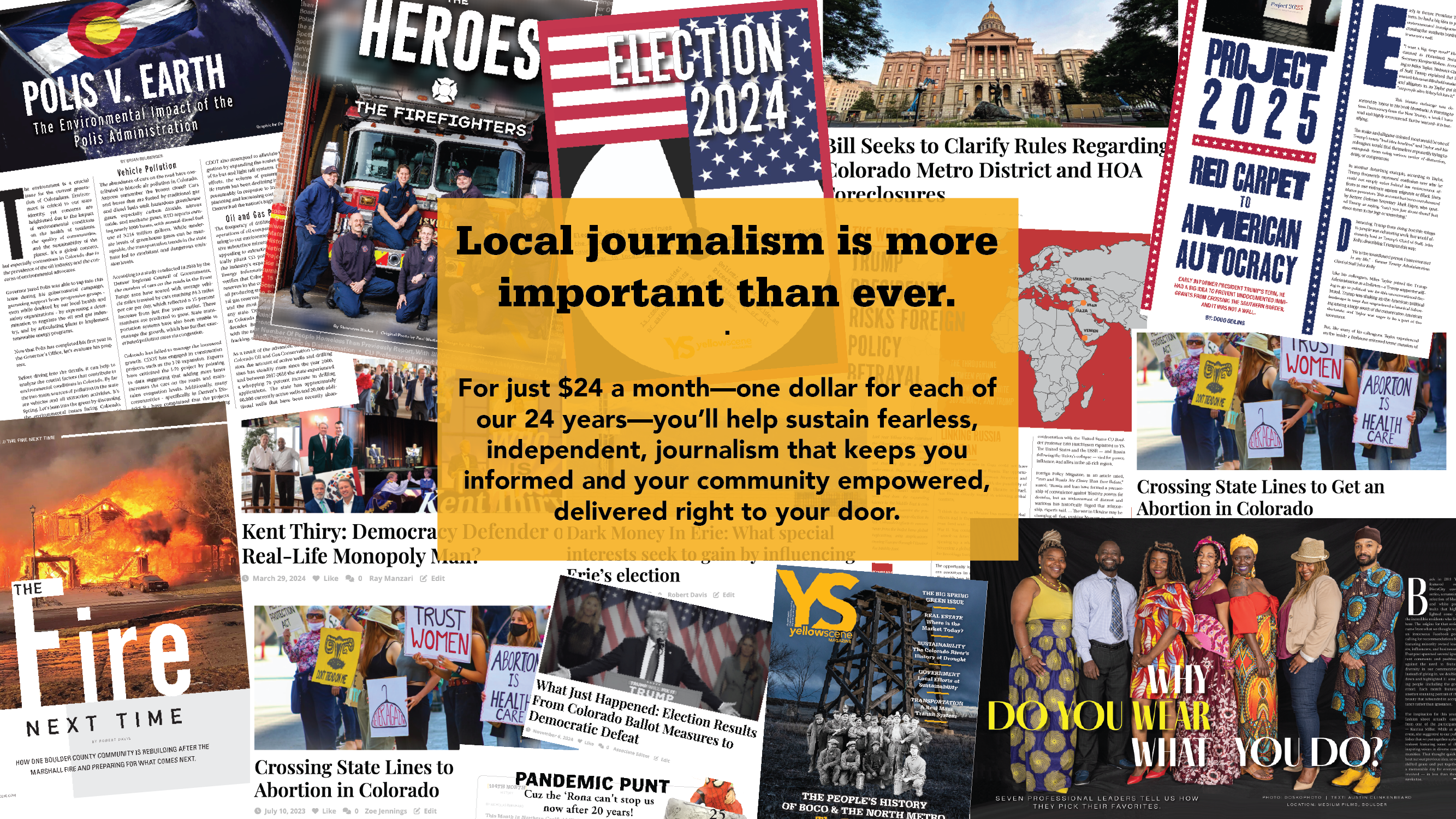
Democracy needs journalism more than ever. We’ve been telling the truth for 24 years. Your support helps us keep telling it for at least the next four years.
link