Harvard Team’s Wearable Robot Helps Stroke, ALS Patients Use Their Arms
WEBVTT
X-TIMESTAMP-MAP=LOCAL:00:00:00.000,MPEGTS:0
00:00.009 –> 00:05.190
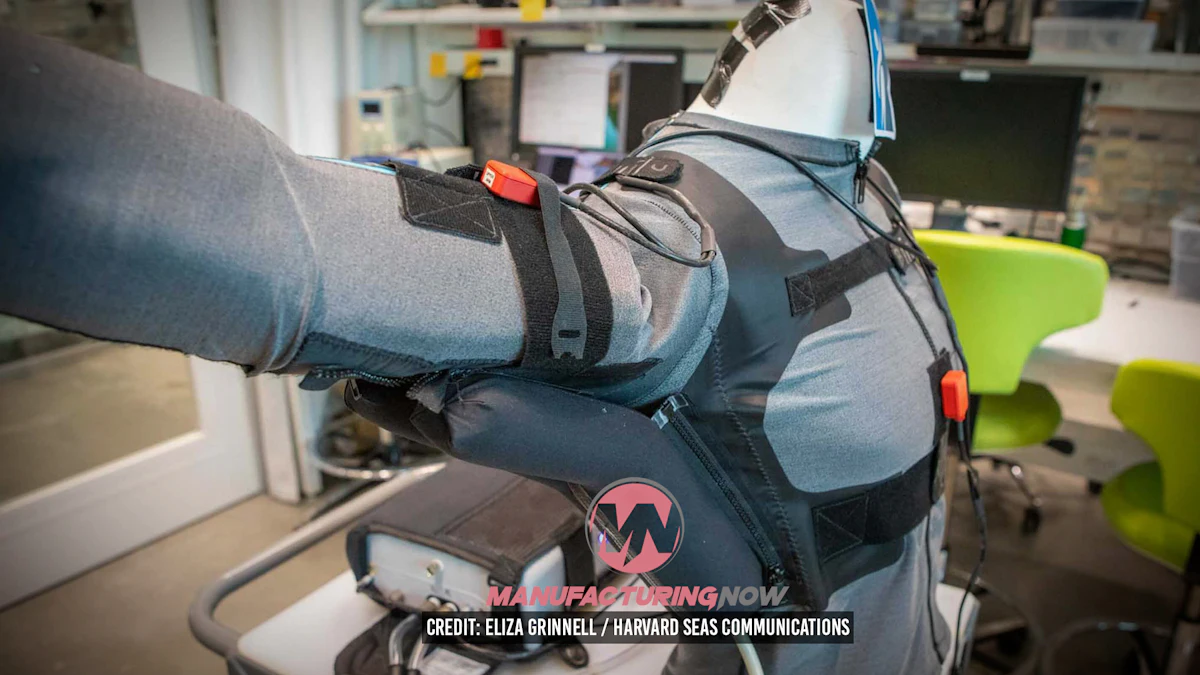
Bioengineers at Harvard have created a soft,
wearable robot that looks more like a smart
00:05.190 –> 00:10.239
jacket designed to help stroke patients and
individuals with neurodegenerative diseases
00:10.239 –> 00:15.439
such as ALS regain a bit of normalcy.
The team has been working on the technology for
00:15.439 –> 00:19.120
years, and the most recent version deploys
sensors, balloons,
00:19.360 –> 00:23.920
machine learning, and a physics-based model to
learn each patient’s unique
00:24.020 –> 00:27.879
movements, all to help them accomplish daily
activities like eating,
00:28.040 –> 00:31.469
drinking, or grooming.
The device provides personalized movement
00:31.469 –> 00:33.970
assistance.
Right now, just for the upper body.
00:34.240 –> 00:39.029
The vest is outfitted with various sensors, as
well as a balloon attached underneath the arm.
00:39.159 –> 00:43.759
The balloon inflates and deflates to provide
mechanical assistance to weak or otherwise
00:43.759 –> 00:47.069
impaired limbs.
The sensors track motion and pressure,
00:47.240 –> 00:50.959
and the machines.
The model personalizes assistance levels by
00:50.959 –> 00:52.250
learning your movements.
00:52.459 –> 00:58.000
Until now, the challenge in creating similar
assistive devices has been that no two patients
00:58.000 –> 01:02.959
move in exactly the same way.
However, machine learning can now offer
01:02.959 –> 01:06.839
personalized care.
Video from a recent study shows the robot
01:06.839 –> 01:11.440
helping steady the arms of a pair of patients,
making it easier for one to take a drink of
01:11.440 –> 01:14.050
water.
And another to comb her hair.
01:14.180 –> 01:17.809
Working with clinical researchers at
Massachusetts General Hospital,
01:18.019 –> 01:23.419
the engineers have tested the device with 9
volunteers, 5 who have experienced a stroke,
01:23.430 –> 01:28.300
and 4 living with ALS.
The robot was able to distinguish the user’s
01:28.300 –> 01:31.180
shoulder movements with 94% accuracy.
01:31.550 –> 01:38.290
And the amount of force required to lower an
arm was reduced by about 30% compared to
01:38.290 –> 01:42.089
previous versions.
Users also demonstrated increased ranges of
01:42.089 –> 01:47.730
motion in their shoulders, elbows, and wrists,
reducing the need to compensate with leaning or
01:47.730 –> 01:51.279
twisting, thus making.
Movements more efficient.
01:51.529 –> 01:56.169
Next, the project’s researchers who have been
supported by the National Science Foundation’s
01:56.169 –> 02:01.040
convergence accelerator under the Directorate
for Technology Innovation and Partnerships,
02:01.290 –> 02:07.239
they hope to continue refining the technology
so that patients can use these robots at home
02:07.970 –> 02:10.039
independently.
I’m David Manti.
02:10.369 –> 02:11.729
This is manufacturing now.
link