How it Changed My AI Workflow Forever
Artificial Intelligence
Date
JSON prompting is here to reshape how you use your chatbots. And it’s already turning out to be better than the traditional method of writing prompts. But how? Let me take you through all the details!
Imagine if Uber didn’t have GPS. Instead, you’d be in the backseat, screaming ‘Left! No, the other left!’, while the
driver takes you on a sightseeing tour of the city. That’s exactly how AI works without JSON prompting—chaotic,
exhausting, and definitely not getting you where you want to go.
And if you have been thinking that your chatbot doesn’t get you, even the premium ones, it might be because of the
kind of prompt you’re using. So, if you do not want to rely on those Saridon tablets you need while using AI chatbots, let me help you out in
understanding what JSON Prompting is and how exactly it is reshaping AI trends.
Let’s go!
What is JSON Prompting?
Simply put, JSON prompting is a technique where instructions for AI models are given in a structured JSON format,
enabling clear, consistent, and machine-readable outputs.
Think of JSON prompting as the difference between:
- Telling a taxi driver, “Just head downtown.” (ambiguous, risky, possibly ending at a
sketchy alleyway)
vs.
- Handing them the exact street address with coordinates. (precise, reliable, no scenic detours through
regret-ville)
That’s JSON prompting. Instead of throwing casual English at
Large Language Models (LLMs), you
feed them instructions in a structured JSON format.
For example:
Regular prompt: “Write a product description for a coffee mug.”
→ You’ll get… something. It might be poetic, long, short, or written like Shakespeare discovered Starbucks.
A real JSON Prompt would look like this:
{
 "task": "productDescription",
 "productName": "Coffee Mug",
 "features": [
     "Microwave safe", "Dishwasher friendly",
     "Keeps drinks warm for hours"
 ],
 "callToAction": "Get yours today and sip in style!"
}
→ The AI follows your blueprint and hands you exactly what you need.
And here’s the kicker: businesses love this because it means AI-generated content can plug straight into
apps, websites, or workflows without needing a cleanup crew.
Traditional Prompting vs. JSON Prompting Techniques
Before we dive deeper into the JSON prompt guide, it’s critical that you know how it differs from the traditional way
of writing inputs for an AI.
Let’s have a look!
| Feature | Traditional Prompting | JSON Prompting |
|---|---|---|
| Structure | Unstructured, conversational language (plain text). | Highly structured, using key-value pairs (JSON format). |
| Precision | Low. Output can be unpredictable and vary in format. | High. You define the exact output schema, fields, and data types. |
| Consistency | Low. The same prompt can produce different results each time. | High. Delivers a consistent, machine-readable format every time. |
| Ease of Use | Very easy for anyone to write, requires no technical skill. | Requires basic knowledge of JSON syntax, has a steeper learning curve. |
| Best For | Creative tasks, brainstorming, content summarization, and general queries. | Automated workflows, API integrations, data extraction, and app development. |
| Integration | Difficult. Requires extra parsing logic to use the output in software. | Easy. The output is already structured for direct use in applications. |
1. Structure
Traditional Prompting is unstructured, just like talking to a person. You write your request in plain, conversational
text without any specific rules.
- Example: It’s a “Smart Mug,” keeps coffee hot, and costs $129.
JSON Prompting is highly structured. You use a specific format with “keys” (labels) and “values”
(the data) inside curly braces {}. It’s like filling out a form where every field is clearly defined.
{
 "productName": "Smart Mug",
 "feature": "Keeps coffee at a set temperature",
 "price": 129
}
2. Precision
Traditional Prompting has low precision. The AI interprets your conversational request, and the output format can be
a guess.
- Example Request: Create a user bio for a developer named Alex who likes chess.
- Possible Output:
“Alex is a developer, and in his spare time, he enjoys playing chess.”
OR
Name: Alex / Hobby: Chess / Job: Developer
You can’t be sure if you’ll get a paragraph, a list, or something else entirely.
JSON Prompting offers high precision. You tell the AI the exact “shape” of the data you want back.
{
 "task": "createUserBio",
 "name": "Alex",
 "profession": "Developer",
 "hobby": "Chess",
 "output_format": {
   "fullName": "string",
   "jobTitle": "string",
   "bio": "string (max 20 words)"
 }
}
- Guaranteed Output Format:
{
    "fullName": "Alex",
    "jobTitle": "Developer",
    "bio": "Alex is a software developer who enjoys the strategic
            challenge of playing chess in his free time."
}
You always get back a JSON object with those specific keys.
3. Consistency
Traditional Prompting is inconsistent. If you run the same conversational prompt five times, you’ll likely get
five slightly different outputs in both wording and format. This makes it unreliable for automated processes.
JSON Prompting is consistent. While the text values might change slightly (e.g., a differently worded bio), the
structure of the output will be identical every time. An application relying on this data will never break because
the jobTitle field will always be there.
4. Ease of Use
Traditional Prompting is incredibly easy. Anyone who can type a question can use it. There is no learning curve.
JSON Prompting has a slight learning curve. You need to understand the basic syntax: curly braces {} for objects,
quotes “” around keys and string values, and commas , between elements. It’s simple for developers but
can be a small hurdle for non-technical users.
5. Best For (Use Case)
Traditional Prompting is best for creative or exploratory AI use cases where format
doesn’t matter.
- Examples: Brainstorming ideas for a marketing campaign, writing the first draft of a blog post,
or summarizing a long document for quick understanding.
JSON Prompting is built for tasks that feed into another piece of software. It excels when data needs to be
predictable and machine-readable.
- Examples: Generating product descriptions to automatically populate an e-commerce website,
extracting names and dates from a document to fill a database, or categorizing customer support emails to route
them to the correct department.
6. Integration
Traditional Prompting is difficult to integrate. If your app receives the text “Alex is a developer”, a
developer has to write extra code (a “parser”) to search that text for a name and a job. This is fragile
and can break easily.
JSON Prompting allows for easy, direct integration. When your app receives {“jobTitle”:
“Developer”}, it can immediately grab the value associated with the jobTitle key. No extra parsing is
needed. It’s a “plug-and-play” solution for software.
7. Visual Stability

I tried generating videos on Veo-3 using one traditional prompt and one JSON prompt. Both results were decent. But,
as you will see in the right GIF above, the JSON prompt offered better detailing and stability but got the spelling
wrong.
The traditional prompt had the character taking a dive, which I hadn’t asked for. So, JSON prompt clearly works
well and requires way fewer attempts to achieve the desired results.
In case you’re curious, here are the AI
prompts I used:
Traditional Prompt
|
|
JSON Prompt
Generate a video with these specifications:
   {
    "video_length": "5 seconds",
    "style": "photorealistic",
    "subject": {
      "entity": "cybertech robot",
      "material": "made of wings"
    },
    "environment": "outer space with multiple planets",
    "shots": [
      {"type": "long shot", "action": "robot flying across planets"},
      {"type": "close shot", "action": "robot flying"},
      {"type": "behind shot", "action": "robot flying, then stopping"}
    ],
    "final_scene": {
      "robot_state": "floating still",
      "perspective": "from behind the robot",
      "planet": {
        "feature": "rings glowing with the text 'MobileAppDaily'"
      }
    }
  }
I also tried using traditional vs JSON prompting to generate an image in GPT.
Traditional prompt
|
Create a photorealistic image of a cybertech robot made of wings |
JSON prompt
{
    "version": "1.0",
    "prompt": "Create a photorealistic cinematic sequence of a
               cybertech robot with glowing wings flying across planets
               in open space,  ending with the robot staring at a planet
               that has 'MobileAppDaily' written as glowing rings.",
    "shots": [
        {
        "id": "shot_1",
        "description": "A photorealistic cybertech humanoid robot with
                        metallic, glowing wings flying gracefully
                        through open space across multiple planets
                        and stars. Cinematic long shot showing
                        the vast cosmic background.",
        "camera": {
            "type": "long_shot",
            "movement": "tracking",
            "focus": "robot flying across planets"
        },
        "style": {
            "visual": "cinematic, sci-fi, photorealistic",
            "lighting": "cosmic glow with contrasting shadows"
        }
        },
        {
        "id": "shot_2",
        "description": "Close-up of the cybertech robot’s head and
                        chest, highlighting glowing blue circuits
                        and reflective metallic textures on its
                        faceplate and wings.",
        "camera": {
            "type": "close_up",
            "movement": "slow_zoom_in",
            "focus": "robot’s facial details and glowing circuits"
        },
        "style": {
            "visual": "high detail, cinematic",
            "lighting": "sharp highlights, cosmic reflections"
        }
        },
        {
        "id": "shot_3",
        "description": "A shot from behind the robot, wings spread
                        wide as it glides toward a distant
                        glowing planet.",
        "camera": {
            "type": "medium_shot",
            "movement": "tracking_from_behind",
            "focus": "robot’s wings and planet in front"
        },
        "style": {
            "visual": "cinematic silhouette, grand scale",
            "lighting": "backlit with planetary glow"
        }
        },
        {
        "id": "shot_4",
        "description": "The robot floats still in space, staring at
                        a massive planet surrounded by glowing rings of
                        text reading 'MobileAppDaily'.",
        "camera": {
            "type": "wide_shot",
            "movement": "static",
            "focus": "planet with text rings"
        },
        "style": {
            "visual": "epic cinematic finale",
            "lighting": "glowing rings illuminating space"
        }
        },
        {
        "id": "shot_5",
        "description": "Final perspective shot from behind the robot,
                        focusing on the planet with glowing
                        'MobileAppDaily' rings. The robot appears small
                         compared to the vast cosmic scale.",
        "camera": {
            "type": "over_the_shoulder",
            "movement": "slow_dolly_forward",
            "focus": "planet and glowing rings"
        },
        "style": {
            "visual": "cinematic, awe-inspiring, photorealistic",
            "lighting": "cosmic glow illuminating the rings"
        }
        }
    ]
}
Here’s the result showing the comparison between traditional (left) vs JSON prompt results
(right).


How to Prepare a JSON Prompt: A Quick Tutorial
JSON prompting is a way of structuring your instructions for an AI model in a clean, machine-readable format. Instead
of writing a long free-form text prompt, you break it down into key-value pairs, making it easier for both you and
the model to understand. Here’s how you can prepare one step by step:
1. Define the Objective: Decide what you want the model to do. For example, generating a video
script, summarizing text, or creating structured data. This will shape the structure of your JSON.
2. Use a Root Object: A JSON prompt always starts and ends with curly brackets { }. Inside,
you’ll organize your instructions as pairs of “key”: “value”.
3. Create Clear Keys: Each key should represent a specific instruction or parameter. For example:
- “title” for the output title
- “description” for a summary
- “style” for tone or format
- “length” for word count
4. Add Values Carefully: The value is what you expect the model to generate or follow. Values can be
strings (“professional”), numbers (500), or lists ([“short”, “engaging”,
“clear”]).
5. Keep it Simple and Valid: Every key must be enclosed in double quotes, and items should be
separated with commas. Always validate your JSON with an online checker to avoid syntax errors.
Example JSON Prompt:
{
 "title": "Mobile App Development Trends 2025",
 "description": "Write an informative blog post explaining the
                 top app development trends for 2025.",
 "style": "professional and engaging",
 "length": 700,
 "audience": "C-suite executives and decision-makers"
}
By following this structure, your prompts become consistent, reusable, and easier for AI models to interpret
accurately.
How to Use JSON Prompt for Videos
Well, a JSON prompting tutorial can be as effective and creative as you can get. There are no rules, except for
following the proper structure of the JSON prompt. So, I will take you through the steps based on the process that I
followed.
Now, here’s what the processed looked like.
Step 1: First, an idea
Before I started working on the JSON prompt structure, the first thing I came up with was an idea that involved
elements like:
- A concept (an unboxing video)
- The purpose (judging the quality of the outcome)
- Kind of shots I wanted (multiple shot types)
- A character (an old man)
- Objective of the character (unboxing the neon sign)
- Filler elements (birds and trees)
- Background (drop-dead gorgeous mountains and waterfalls)
Step 2: Now, draft a rough prompt
With every element now clear in your head, prepare a rough prompt. Make it as detailed as you can.
Here’s how my rough prompt looked!
|
Give me a ready-to-use video prompt for Veo 3 Gemini. An old guy |
Step 3: Convert the prompt into JSON
There are two ways to convert a normal prompt into JSON:
If you know the structure well, do it manually, but it’s time consuming.
I prefer the alternative. I ask GPT to convert my prompt into JSON prompting and edit it to refine it.
Let me show you how JSON based on the above output looked once I asked GPT to do the job for me.
{
  "video_length": "10 seconds",
  "style": "photorealistic, cinematic, rich colors",
  "setting": {
    "location": "remote jungle",
    "environment": [
        "wild exotic birds",
        "lush greenery",
        "waterfalls",
        "mountains in the background"
    ]
  },
  "character": {
    "type": "old man",
    "action": "unboxing a product in the jungle"
  },
  "props": [
    {
        "object": "box",
        "contains": "neon red glowing sign with text 'MobileAppDaily'"
    }
  ],
  "shots": [
    {
        "type": "wide shot",
        "description": "captures the old man, the box,
                    and the surrounding jungle scenery"
    },
    {
        "type": "POV shot",
        "description": "from the man’s perspective as he lifts the
                        glowing 'MobileAppDaily' sign from the box,
                        showing his hands holding it"
    }
  ],
  "visual_tone": "immersive, cinematic, vibrant and detailed"
}
Step 4: Test and Adjust
Run the prompt and look at the output. Is the output right? Are details captured well? You can tweak your
JSON—maybe add a rule to exclude certain terms—and try again. This back-and-forth is a core part of JSON
prompting best practices.
Here’s how the final result looked!

How to Use JSON Prompt for Your Images
If you’re planning to integrate AI in marketing activities, you need good images too. Your prompt has to be
perfect to achieve these images. While preparing a prompt, apart from including details of the visuals, you also
need to ensure that the images are compliant with standards like WCAG.
- Start with an idea
- Convert it into a traditional prompt and then a JSON prompt manually or using GPT
- Don’t forget to review the prompt once before using it
The process of prompting with JSON almost looks the same as the one you explored for videos above. But upon testing
tons of AI chatbots, AI image generators, and AI video generators, I found GPT’s Sora image generator the best.
I used these prompts for each result.
Traditional Prompt (left)
|
generate an image of a dragon surrounding Saturn, but it looks like |
JSON Prompt (right)
{
"version": "1.0",
"scenes": [
    {
    "id": "scene_1",
    "description": "A photorealistic cosmic scene featuring Saturn.
                    Instead of its natural ring, a massive dragon coils
                    around the planet, forming Saturn's ring.
                    The dragon has detailed scales, glowing eyes,
                    and an ethereal aura, blending seamlessly with
                    the planet's atmosphere. The colors are rich, with
                    deep purples, silvers, and golds, and the scene
                    has strong gothic vibes with dramatic lighting
                    and shadows. The background shows a vast star
                    field with nebula clouds for added mystique.",
    "style": {
        "realism": "photorealistic",
        "theme": "gothic",
        "color_palette": [
            "deep purple", "silver", "gold", "black"
        ]
    },
    "camera": {
        "type": "wide_shot",
        "focus": "Saturn with dragon-ring",
        "angle": "slightly tilted for dramatic effect"
    },
    "lighting": {
        "type": "dramatic",
        "sources": [
            "cosmic light glow", "dragon’s glowing eyes"
        ],
        "shadows": "enhanced gothic contrast"
    }
    }
]
}
Here’s how the results looked!

How to Build a Web Page using JSON Prompt
Well, here you will have to get more detailed. To build a webpage, you will need to define the kind of webpage you
want. Is it a game, or a marketing page to bring conversions? It’s all about the goal you want to achieve.
Here’s everything you need!
1. Core idea: You describe the page, sections, components, AI, and behavior in JSON. A renderer
(your own script or a no-code/AI tool) reads that JSON and builds the actual page.
2. Additional details like:
- metadata – title, description, SEO
- theme – colors, typography, spacing
- layout – header, main, footer
- components – hero, cards, forms, CTA
- assets – images, icons
- interactions – onClick, animations
- data – content or API bindings
Steps to Build a Web Page Using JSON Prompt
1. Define the goal: What should the page help the user do? (e.g., sign up, read an article, buy)
2. Sketch sections: List the blocks you need: Hero → Features → Social Proof → CTA
→ FAQ.
3. Choose a schema: Decide on your property names and types (keep them consistent).
4. Write the JSON prompt: Capture copy, layout, and behavior in a single object.
5. Render
- Use a script that converts JSON → HTML/CSS/JS, or
- Paste the JSON into your generator/AI that supports JSON prompts.
6. Preview & iterate: Tweak text, spacing, and actions in JSON—re-render quickly.
For a demo, I tried to build an offline game that works on mainstream browsers like Chrome, even without the
internet.
I first tried a traditional prompt on Grok’s free version, which auto-picks the model.
Traditional Prompt
|
Build a webpage game that works offline on any browser, preferably |
JSON Prompt
{
 "version": "1.0",
 "title": "Robot Catching Falling Letters",
 "platform": {
     "type": "web",
     "offline": true,
     "browsers": [
        "Chrome","Firefox","Edge"
     ]
 },
 "graphics": {
     "dimension": "2D",
     "style": "colorful, visually rich",
     "background": {
     "theme": "alien planet",
     "elements": [
         "waterfalls", "trees",
         "strange animals", "distant scenery"
     ]
     },
     "characters": {
     "player": {
         "type": "robot",
         "controls": [
            "left_arrow", "right_arrow"
         ],
         "animations": [
            "move_left", "move_right", "thumbs_up"
         ]
     },
     "objects": {
         "falling_letters": {
            "sequence": "MOBILEAPPDAILY",
            "spawn_behavior": "random_x_position",
            "fall_speed": "constant"
         }
     }
     }
 },
 "gameplay": {
        "objective": "Catch falling letters to gain points",
        "scoring": {
        "points_per_letter": 1
     },
     "timer": {
        "duration_seconds": 120,
        "end_behavior": "game_over"
     },
     "high_score": {
     "storage": "local",
     "popup_on_new_record": {
         "message": "Congrats on securing the highest score!",
         "visuals": {
            "robot_action": "thumbs_up",
            "effects": [
                "glow", "celebration_animation"
            ]
         }
     }
     }
 },
 "replayability": {
     "restart_option": true,
     "loop_play": true
 }
}
Let me show you the difference between the results.

On the left side of the result, you will find better visuals, but it sacrifices frame rate. There are jerks that can
be felt. It also missed elements in the background that I had asked for, like animals, mountains, etc.
The right side of the result was smoother, fulfilling its purpose, but lacked some details, too. But if you ask me, I
will pick a smoother experience over extra visual aesthetics any day. So, JSON prompt worked better here as well,
and this is how you can leverage AI in
web development.
How to Use JSON Prompts to Draft a Blog
Beyond writing and structuring the blog, a JSON prompt can also tell the AI to fact-check online before finalizing
the answer. This ensures your blog or FAQ is not just structured, but also accurate and up to date.
Here are the steps!
- Step 1. Define the task: Specify whether you want writing, outlining, or FAQs.
- Step 2. Create a JSON structure: Use fields like “task”, “topic”,
“tone”, and “length”. - Step 3. Add accuracy checks: Include a field such as “verify_sources”: true or
“cross_check”: “latest stats”. This instructs the AI to search the web before writing. - Step 4. Run the prompt in your AI tool: Paste the JSON into a model that supports browsing or
live data. - Step 5. Review and refine: Check if the cited facts have timestamps, sources, or links. Adjust
if needed.
I tried Gemini 2.5 Pro for this task with both types of prompts.
My prompts were:
Traditional Prompt
|
Draft me a 500-word SEO-friendly blog on How far are we from AGI? It |
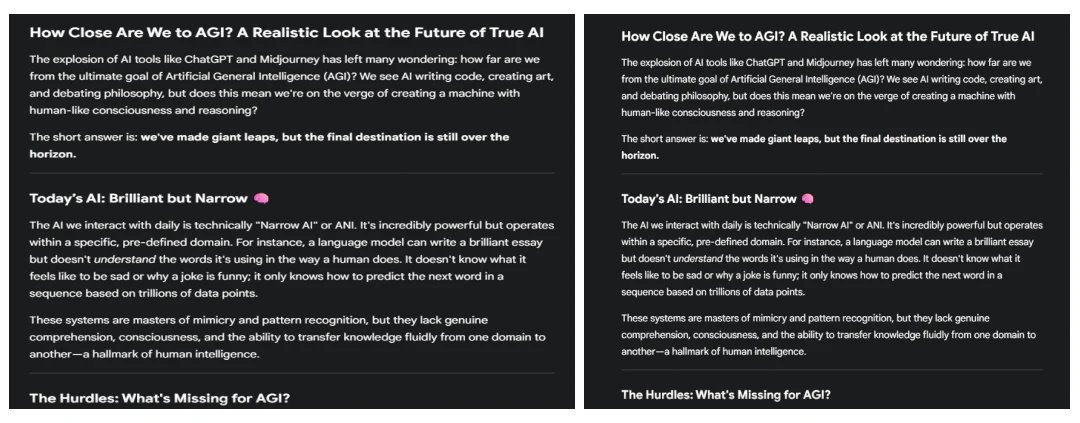
I faced certain challenges while drafting a blog. For instance, the final outcome was coming into JSON format as
well, which made it difficult to paste the blog into a Google Doc. There were no research links either.
So, it’s definitely not for writing full, ready-to-use write-ups for now. But you can use the same process to
draft e-mails, CTAs, marketing copies, and more such content that doesn’t require much research or
SEO-friendliness.
I also checked the AI score using AI
content detectors like ZeroGPT. The traditional prompt resulted in 48% AI content, while the result from
JSON-prompt (on the right) resulted in 27% of AI content.
Benefits of JSON Prompting
Switching your method gives you some serious JSON prompting benefits, especially when you’re trying to scale up
your AI efforts. It turns your AI from a creative-but-unreliable brainstormer into a predictable workhorse.
Here are the main advantages of a JSON prompt:
- You Get Exactly What You Ask For. No more guesswork. When you define the output fields, data
types, and even character limits, the AI has no choice but to give you exactly that. This is a huge deal for AI in Customer Service, where
you might need structured data for support tickets. - Consistency You Can Count On. Automated systems choke on inconsistent data. JSON prompting
ensures the AI’s output format never changes, making it perfect for feeding data into databases or other
applications. - It Plugs Right In. The AI’s response is already in a format that machines understand. This
saves your developers a ton of time and headaches, speeding up the entire process by integrating AI in App
Development more smoothly. - Fewer Weird Mistakes. By giving the AI a tight structure to follow, you limit its ability to go
off-topic or “hallucinate” incorrect information. You’re putting guardrails on its creativity,
which is essential when you need factual, user-friendly AI Products. - Scales Easily Across Teams. Once you define a JSON template, anyone on the team can reuse
it—whether it’s for customer support logs, analytics summaries, or marketing copy. This means less
“prompt engineering” guesswork every time. - Easier Automation & Integration. JSON output drops directly into APIs, CRMs, or workflow
tools without needing heavy post-processing. That’s a big win for businesses trying to automate reporting,
content pipelines, or chatbot logs. - Transparent for Debugging. If the AI produces a wrong answer, you can pinpoint exactly where it
failed (e.g., wrong field, invalid data type) instead of sorting through vague paragraphs of text. - Supports Multilingual & Multi-Domain Workflows. You can define language codes, tone styles,
or domain-specific requirements right in the schema. That makes it practical for global businesses running the
same AI across multiple markets. - Predictable Training & Fine-Tuning. When you’re collecting data to improve your
models, JSON outputs are gold—clean, structured, and ready for machine learning pipelines without human
reformatting.
Challenges of JSON Prompting
Of course, it’s not a silver bullet. There are a few things to keep in mind before you go all-in on this method.
- It’s More Technical. Let’s be honest, this isn’t as simple as typing a sentence.
You need to know how to write a valid JSON object, which can be a hurdle if you’re not a developer. - Your AI Model Matters. Not all Large Language Models handle structured inputs equally well.
Some of the newer models have specific “JSON modes” that work beautifully, but others might struggle
to follow your schema. Choosing the
right AI development platform is key. - More Upfront Work. Crafting a good JSON prompt takes more planning than writing a quick text
prompt. You have to think through your data structure and define exactly what you need, which takes a bit more
time at the start. - Validation Errors Can Break Output. A single missing comma or mismatched bracket can cause the
entire prompt to fail. Unlike natural language prompts, JSON demands perfect syntax, which means small mistakes
can cost you a whole run. - Limited Flexibility. JSON works best when you know exactly what you want. But if your request
is more open-ended or creative, rigid structures can box in the model and reduce the variety of outputs. - Harder for Non-Technical Teams. If you’re collaborating with marketers, designers, or
business managers, JSON prompting may slow things down because they can’t easily draft or tweak structured
prompts without technical support. - Scaling Gets Complex. The more attributes and nested structures you add, the harder it becomes
to manage and reuse your prompts. Maintaining consistency across multiple JSON templates can feel like software
development in itself. - Not Always Human-Readable. Unlike plain prompts that anyone can skim and understand, JSON
prompts can be harder to review quickly—especially for stakeholders who just want to check if the request
makes sense.

So, to wrap up…
If You Ask Me, JSON prompts turned chaos into clarity. Instead of wasting time fixing messy AI outputs, I now get results I can actually use—fast, structured, and reliable. And in a world where speed and precision mean everything, JSON prompting isn’t just a trick; it’s the upgrade your AI has been waiting for.
Frequently Asked Questions
-
What does JSON stand for?
-
Is JSON prompting better?
-
What is JSON prompting most used for?
-
Can I use JSON prompting with any AI model?
-
How do I validate a JSON prompt?
-
What tools help create JSON prompts?
WRITTEN BY

link