Competing in Categories No One Wants to Revisit
The Gist
- Customers aren’t actively shopping these categories. Insurance, telecom, banking and similar services live in the background of daily life, revisited only when a bill spikes, service fails or a life event forces reconsideration.
- Habit and friction beat persuasion. Defaults, inertia and switching hassle explain low churn far better than creative quality, making clever campaigns less influential than marketers assume.
- Mascots, jingles and even “anti-mascot” messages do the same job. They exist to support memory and recognition so a brand surfaces quickly when a rare trigger moment opens the category.
I watched a commercial from an insurance company the other day. The big message was that they do not use jingles or mascots. I immediately turned to my wife and said, “Honey! The moment has come! Just what we’ve been waiting for! No jingles or mascots? I want this insurance!”
The whole advertising campaign was ridiculous. Can I quantitatively say that? No…I don’t work there and haven’t seen data. But I (sometimes) still rely on this old concept of employing common sense. I do not remember anyone, ever, claiming that a jingle was the reason they chose an insurance provider or that the absence of one made the decision feel smarter.
Most people cannot explain what their current policy covers. They do not remember their deductible. They do not know what is excluded. They don’t even notice when their rates change, for the most part. They do not know the difference between any of these companies. Yet they likely know who Flo is (she went to my high school, by the way), find the gecko cute, etc. How do I know this? Keep reading to find out.
Table of Contents
Brands’ Distorted View of Customers and Prospects
This goes way beyond insurance. Wireless carriers, cable companies, credit cards, gas stations and banks all live in the same category of products people use every day but think about almost never. I am not arguing that it never matters which carrier you pick, which credit card you carry, or which bank you use. Those decisions can affect real money, real service quality and real convenience. I even recently had an experience where I needed to change insurance providers and found out I was severely under-covered with my current provider.
The point is that most people do not invest the mental bandwidth to evaluate those differences with any meaningful effort or interest. They likely would agree that the decisions on these matters are important in theory, but that’s about where the conversation ends.
Do a simple experiment. Ask your friends or family whether they carry a Visa or a Mastercard and note how many answer confidently without pausing, guessing, or checking their wallet. Most will say Visa, not because they know, but just based on probability as Visa has a larger share of the market. Then ask the follow-up question: do you care which one you have? The typical answer will sound like a verbal shoulder shrug. The deeper issue is not that people lack intelligence. The issue is that the perceived value of thinking harder does not outweigh the effort required to care.
Ask the same group why they chose their cable provider, their mobile plan, or their bank, and the answer often sounds like a shrug in sentence form, as well. If you ask whether they plan to switch, the likely response is a flat “no” followed by “why bother.”
The tension is simple. These industries advertise like consumers are waiting for a breakthrough. Consumers behave like they finished the decision years ago and do not want to revisit it.
The Categories People Live With and Barely Think About
There is a very specific type of purchase that fits this pattern. You need it. You pay for it. You do not want to talk about it.
When you listen to brand teams in these sectors, you hear big language about preference, loyalty, and emotional connection. When you listen to consumers, you hear something closer to, “I buy the product, not the brand.” More than half of Americans say they ignore brand names entirely when buying many consumer goods, focusing on whether the item meets their needs, according to recent consumer research. That is in categories that are easier to switch than an insurer or a broadband provider.
Academic and practitioner work on low involvement decision-making points to a consistent pattern. When the category feels routine, mandatory and complicated, people invest as little mental energy as possible. That is not laziness. It is a practical response to excess choice and limited time.
Marketers in these industries are not starting from a blank slate. They are starting from a default setting called, “I do not care to think about this again,” or in my view, a life so busy, this isn’t even on their radar.
Related Article: Why Most Brands Fail at Customer Loyalty (And How to Succeed)
High Spend, Low Movement
Across telecom, insurance and financial services, the most aggressive advertising spenders are often competing hardest in markets where customer movement is structurally limited.
| Industry | Advertising Spend Behavior | Customer Churn Reality | Key Evidence |
|---|---|---|---|
| Telecom & Wireless | Among the fastest-growing digital ad spenders, with year-over-year growth exceeding 20% | Monthly postpaid churn under 1%, translating to roughly 10–11% annual switching | Industry analysis; Sector benchmarks; T-Mobile (0.89%), Verizon (0.91%), AT&T (0.92%) |
| Insurance | Global advertising market measured in the billions and still growing, led by auto and property lines | Low consumer enthusiasm and high friction, with switching constrained by complexity and fine print | Market analysis; Advertising spend reviews |
| Credit Cards | Top five U.S. issuers spent over $18.7B on marketing in 2024, led by American Express and Capital One | Annual churn around 25%, yet most cardholders remain despite predictive risk modeling | Churn benchmarks; Portfolio analysis |
The Human Behavior Wall: Inertia, Default and Friction
It is easy to blame creative or media strategy for weak movement. The deeper issue is behavioral. People are biased toward the status quo. Behavioral economists call this the default effect. People stick with preselected options even when attractive alternatives exist, because change requires effort and introduces uncertainty. Controlled experiments consistently show that a shift from opt-in to opt-out drives large swings in participation without changing the underlying offer, as documented in default effect research. Field trials and lab studies replicate the same pattern across contexts, as covered by behavioral practitioners.
Now add real-world friction to that bias. Switching a health plan, card, insurer, or broadband provider is rarely a single click. It means forms, identity checks, reconfiguring devices, changing autopay and reading language that feels intentionally dense. Studies on financial products show very low switching rates even when tools highlight better options, because the combination of cognitive burden and administrative hassle outweighs the potential gain for most people, as shown in behaviorally informed switching work.
This is the wall these industries keep running into. It is not that consumers do not understand a clever line. Their brain simply prefers the current mess over the work of cleaning it up.
Nobody Is Actively Shopping Your Category
Marketers like to imagine a funnel where people move neatly from interest to evaluation. In these categories, the funnel looks more like a locked cabinet that only opens during certain life events.
Shopping often follows specific triggers, such as a move, a major claim, a job loss, a rate increase, or a policy shift. Health coverage research confirms that changes cluster around discrete qualifying life events, such as job loss, marriage, childbirth, or relocation, not steady comparison shopping, with LexisNexis data showing that insurer outreach and renewal notifications prompt existing customers to reassess coverage during these trigger moments. People are not browsing alternatives on a quiet Sunday. They are reacting to disruption.
Cable and streaming show the same split between talk and action. Surveys find a meaningful share of subscribers say they are likely to cancel cable, yet actual churn is much lower. Many stay with a provider they dislike because the perceived hassle outruns the frustration, a pattern captured in polling about the “too much hassle to change” problem. At the same time, cord-cutting accelerates when a larger cultural or financial shock hits, as shown in cord-cutting statistics. The switch depends less on a slogan and more on a shove from reality.
People do not wake up eager to re-evaluate their carrier or their pump. They make those choices when something breaks, when a bill jumps, or when they move. The rest of the time, your category lives as background noise.
The Say–Do Gap Marketers Ignore
Ask consumers what they care about and you will hear all the right answers. Value. Service. Transparency. Many will say they are open to switching and that they want better options. Traditional research takes those responses at face value. Behavior does not.
There is a significant gap between what people say they will do and what they actually do. The intention–action gap is well documented across health, finance and daily habits, where stated plans only partially predict real behavior, according to work from behavioral researchers. Insight teams warn that taking verbal claims literally can lead to expensive misreads of demand because surveyed “openness” does not convert to revealed preference, as explained in guidance on the say–do gap.
So when people tell you they are open to a new card, new insurer, or new carrier, you have to discount that signal. They may be honest in the moment. It still does not mean they will go home, open a laptop, and initiate a multi-step switching process.
Habits Make More Decisions Than Preferences
A surprising portion of everyday behavior is habitual. That does not mean mindless. It means patterned. Once a person has repeated the same action in the same context enough times, the brain turns that choice into an automatic response.
Research on habitual purchase and consumption shows that repeated choices create stimulus–response links in many product categories. However, fuel and convenience store purchasing defies this pattern. Studies of this type of retail behavior show that location and convenience dominate choice, with “convenient location” cited by over 67% of consumers. While many customers visit the same brand repeatedly (data from 2020), this reflects geographic convenience rather than brand loyalty. Essentially, they’re choosing the station on their commute route, not seeking out the brand.
From a brand standpoint, you face two options. You either become the habit, which takes time and consistent presence, or you try to disrupt the habit, which takes a serious jolt. Neither path relies on clever wordplay. Both require repeated, recognizable signals tied to real-world triggers.
Related Article: The Customer Experience Mismatch That Ruins Brand Perception
Why Mental Availability Beats Persuasion
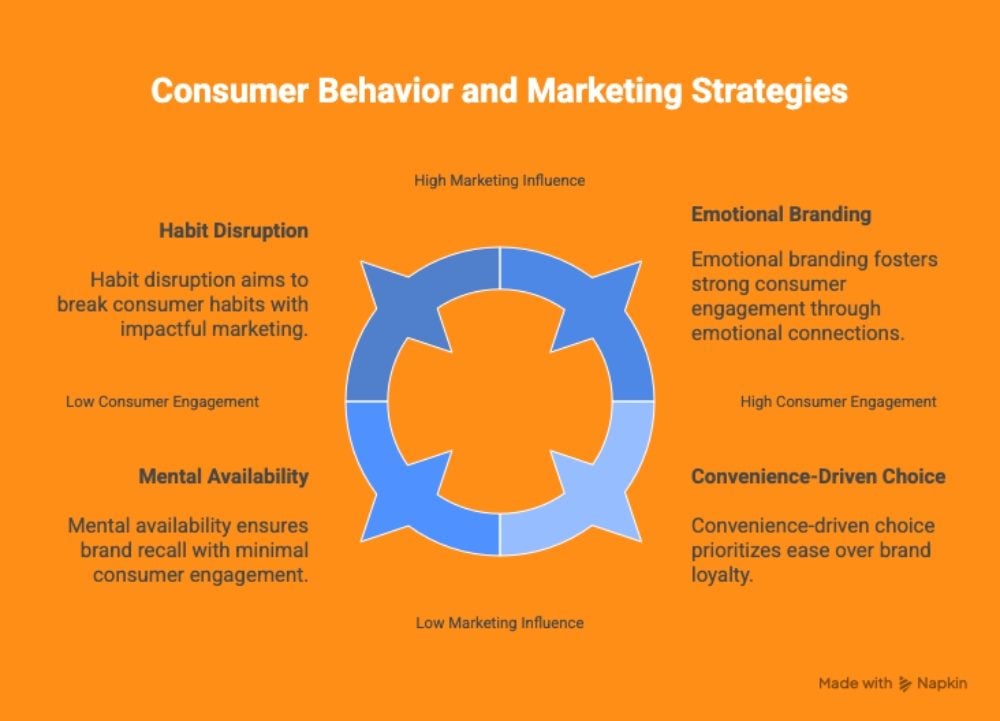
If people are not actively shopping, and if habit and defaults dominate, what is advertising doing in these categories? It is not primarily about persuasion in the classical sense. It is about memory.
Brand research over the past decade has centered on the idea of mental availability. The brand that gets chosen is often the brand that comes to mind quickly in a relevant situation. Work focused on category entry points and memory structures argues that the role of distinctive assets and consistent cues is to build mental shortcuts so the brand is easier to recall at the time of need, as outlined in guidance on category entry points and resources for mental market share.
This explains why categories that feel boring still lean on characters, slogans, colors and recurring lines. These elements are not entertainment. They are memory hooks. Emotional campaigns also tend to create stronger, longer-lasting memory traces than purely rational ones, which is why long-term brand building often favors emotional framing, as shown in work comparing emotional and rational creative.
When the decision moment finally arrives, a person does not pull up a spreadsheet. They grab the first few brands that feel familiar and reasonable. The job of advertising is to make sure you live in that short list when the window opens.
The Commoditization Trap Underneath all of This
Part of the reason these industries shout so loudly is that their products look interchangeable from the outside. Once basic features converge, markets slide toward commoditization. Strategy research describes a familiar pattern. Products become harder to distinguish. Pricing pressure intensifies. Margins shrink. Firms end up competing on cost rather than value, as laid out in work on competing in commoditized markets.
In commoditized environments, brand becomes one of the few levers left. Not because it magically fixes a weak product, but because it influences which similar product even makes it into the consideration set. Thought leadership frames this as a fight to avoid becoming an anonymous commodity in a race to the bottom, where only the lowest-cost producer survives, as explained in analysis of product commoditization (article from 2007).
That is the backdrop for the “no jingles, no mascots” message. It is not a rejection of the game. It is the same move in different clothing. The line itself becomes the device. It functions as a memory cue the way a character or tune would. The mechanism does not change: repeat a simple, distinctive signal often enough so a tired consumer recalls your name in a crowded, boring field.
From Insight to Action in Low-Engagement Markets
When customers avoid thinking about your category, effective marketing shifts from persuasion to friction reduction, trigger readiness and trust preservation.
| Strategic Reality | What This Means | Actions Marketers Should Take | Source & Context |
|---|---|---|---|
| Repeat behavior is not loyalty | Customers stay due to habit, convenience or default bias, not emotional commitment | Treat loyalty programs as tools to manage inertia, not proof of brand attachment. Design benefits that matter during reconsideration moments, not everyday usage. | CMSWire analysis on repeat behavior |
| Loyalty programs are overloaded | Most consumers already carry more programs than they can track, many unused | Make programs passive and utility-driven: automatic enrollment, automatic accrual, obvious redemption and benefits that reduce effort or risk when it matters. | Observed across insurance, cards, fuel and telecom categories |
| Utility beats status | Points and perks alone do not convert indifference into preference | Focus rewards on reducing friction: fee forgiveness, expedited service, simpler claims, automatic credits or one-click updates. | Loyalty functions as table stakes, not differentiation |
| Habit spend hides true impact | Frequency created by habit can mask whether a program actually drives choice | Measure incremental value net of cannibalization. Separate habit-driven spend from spend caused by the program itself. | Program economics discipline |
| Programs are a cost of sale | If a program does not change choice, it functions as a tax | Price programs like acquisition or retention costs. If they do not influence reconsideration moments, redesign or remove them. | Loyalty ROI framing |
| Advertising works differently here | The market is mostly inactive, with rare moments of reconsideration | Shift advertising goals from constant conversion to: mental availability, simple reasons to choose you, and reassurance that switching is safe. | Low-engagement category dynamics |
| Strong brands earn better ROI | Returns come from trust and recognition, not hyper-efficient campaigns | Invest consistently to maintain a seat at the table, even though most impressions will not convert immediately. | BCG marketing ROI analysis |
| Trigger moments drive switching | Customers re-enter the market only when forced by an event | Map trigger moments and organize media, creative and offers around those windows rather than generic campaign calendars. | Category re-entry behavior |
| Friction protects incumbents | Complexity and perceived risk keep customers from moving | Treat friction as the primary competitive enemy. Simplify forms, steps and policies so switching feels calmer than staying put. | Operational CX insight |
| The enthusiast does not exist | Most customers want to think about your category as little as possible | Stop writing for an imaginary enthusiast. Communicate clearly, briefly and reassuringly to people who prefer not to switch. | Messaging and content strategy |
Back to Jingles and Mascots
Which brings us back to that commercial. An insurer saying “no jingles, no mascots” is not a break from the game. It is the same game in different clothing. The line becomes the device. It works like a character or a tune: a simple cue repeated until it sticks. Most people will not switch because of a character, and they will not switch because you refuse to use one. They will switch when a bill spikes, a claim goes badly, a service fails, or life forces a new choice. In that moment, they reach for a brand they remember, a promise that reads clean, and a process that looks easier than staying put.
Why This Does Not Conflict With My Stance on ‘Awareness’
It does not. In my CMSWire piece on “awareness,” I argue that top-of-funnel exposure without intent, context or operational follow-through is wasted spend. The point here is different:
- Objective: This argument is about readiness at trigger moments, not generic exposure.
- Mechanism: The job is memory support plus friction removal, not vague “visibility.”
- Measure: Success is switching behavior and completed conversions, not impressions or recall scores.
- Operations: Creative only matters if pricing, claims, service, and sign-up make moving feel safe and simple.
In short, I am not defending “awareness” as a goal. I am defining mental availability tied to action. If the category opens a brief window to change, you need to be retrieved from memory and you need to make switching easy. Anything short of that is noise, which is exactly why “awareness” on its own has no value.
The Paradox
The categories that advertise the most are often the ones people care about the least.
The brands that win are not the ones with the cleverest line or the loudest campaign. They are the ones that hold a quiet, durable place in the back of a distracted mind and make the next move feel safe when indifference finally gives way to action.
 Learn how you can join our contributor community.
link