Navigating New Roads the Winnebago Industries Way
The Gist:
- Strategic diversification. Winnebago Industries has expanded into multiple brands and products to meet evolving consumer demands.
- Tech advancement. The company integrates technology like mobile controls to enhance the user experience and attract younger consumers.
- Segmentation insight. Effective market segmentation allows Winnebago Industries to maintain unique identities across its brand portfolio without cannibalization.
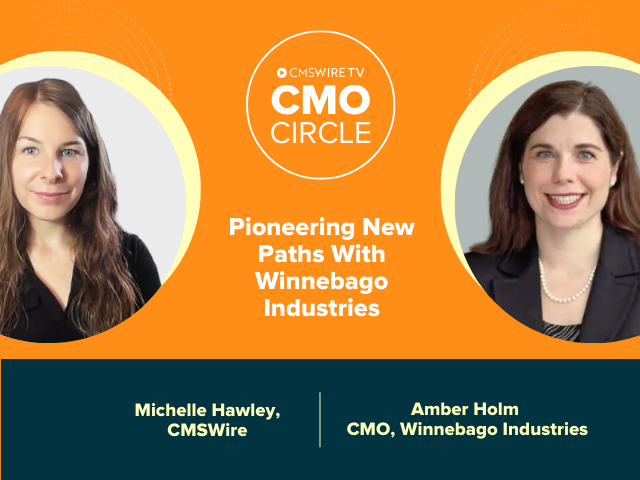
Amber Holm, senior vice president and chief marketing officer at Winnebago Industries, delves into the complexities of managing a brand that has continuously evolved over 60 years.
In this episode of CMSWire’s The CMO Circle, Holm discusses the strategic expansion from a single-brand motorhome manufacturer to a diverse portfolio of outdoor lifestyle brands. She explores the integration of technology to enhance product offerings and customer interaction, the importance of market segmentation to prevent brand cannibalization and the key role of community building in fostering brand loyalty and growth.
Table of Contents
Episode Transcript
Michelle Hawley: Hi everyone, and welcome to another episode of CMSWire’s the CMO Circle. Today we have an exciting guest with us, Amber Holm, the senior vice president and chief marketing officer at Winnebago Industries.
Amber is going to give us an inside scoop on what it’s like to manage marketing for a brand that has evolved over more than 60 years and the challenges and unique opportunities that come with managing a multi-brand portfolio.
Hi, Amber, thank you for joining us today and giving us an inside look at your role at Winnebago Industries. So, I want to start by asking you a little bit about Winnebago. The brand has a rich history dating back to 1958. Can you walk us through how the brand has evolved to meet the needs of modern consumers while still staying true to its heritage and your legacy customers?
Amber Holm: Yeah, thanks for having me. Glad to be here. So, I represent Winnebago Industries, which is our corporate brand, which has now evolved from a single-brand motorhome manufacturer to a portfolio of premium outdoor brands. We’ve got three RV brands, two boat brands and a lithium-ion battery business as well. Each of these brands has evolved in specific ways, but I can talk about our core flagship Winnebago brand.
Not only is it our core brand, but it continues to be one of our most important flagship brands, as I said. This brand has been around since 1958 and was truly a pioneer in the RV industry and is really an iconic American brand. For us, we do want to make sure that it’s relevant for the next generation of consumers. I think the good news is we’re starting from a place of strength because it’s always been about providing outdoor experiences for our consumers, and today’s consumers want outdoor experiences as much as they did way back when because it provides mental health benefits, physical health benefits. So that’s a great starting point.
But for us, we want to make sure that people think that the Winnebago brand is for them today. So first, it starts with knowing our consumers and what they want. We have a strong consumer insights practice here at Winnebago Industries. And then for us, it’s really about having a product offering that meets those needs as well.
For Winnebago, you might think about the big class A motorhomes traditionally that might have targeted baby boomers, and we still have those and they’re still important to us, but we’ve added to our portfolio with class B camper vans and class C RVs. Class B, in particular, the Winnebago brand has been a pioneer in that space with our Revel, Solis and Travato products. These are smaller, so they let consumers go off-grid, they are easier to maneuver and drive and so they’ve really opened up RVing to a whole new group.
So, I think having the right products is really important, so we continuously think about our product pipeline. And then as we think about our marketing and digital marketing to reach those consumers, and ultimately even connecting our products. We have Winnebago Connect, which is an RV system that you can control with your phone. It’s intuitive. You can set the climate, turn on the lights and do everything kind of to monitor the vehicle right from your phone. And so that’s something again that today’s consumers and younger consumers really look to as well. So I think for us it’s the product, the marketing and just making sure we’re understanding those consumers as a starting point.
Creating a Unique Identity Across Multiple Brands
Michelle: You mentioned there being multiple brands within Winnebago Industries. So in your role, how do you go about making sure each brand has that unique identity without them kind of cannibalizing each other?
Amber: Yeah, that’s really part of the fun. I mean, as I said, I think one thing that all the brands have in common is they help elevate every moment outdoors. And that’s what our corporate purpose is about. But then we want each brand to be distinctive. And so again, I think you’ll hear a theme from me. It starts with our consumers. So really understanding who our consumer targets are.
So we do segmentation of the RV and marine markets to understand those attitudinal and behavioral consumer groups. So we can think about: what do consumers want? And that way when you look, for instance, in RV across our three brands, Winnebago, Grand Design RV and Newmar, they each target different consumers and then they each offer products and solutions that then meet the needs of those consumers.
So Winnebago’s got the full lineup of motorhomes as well as towables which are travel trailers. Grand Design has always been in travel trailers and fifth wheels but Grand Design’s actually launching into motorized as well. They just launched Lineage, which is their first motorhome. It’s a class C. And then Newmar is kind of high-end luxury motorcoaches that can range up to, you know, $1.7 million, I think is the most expensive Newmar that we make.
So for us, I think it’s again, starting with the consumers on what their wants and needs are, and then specifically positioning each brand separately and being true to their brand architecture and brand positioning as a North Star in all that they do, which enables us to really try to grow all of the brands together. We don’t want to just cannibalize.
I think the other piece that helps us do that is having a central marketing group that I lead, like our marketing center of excellence. And I think sometimes that may have a negative connotation in some places if there’s a center team and teams in the business units. But for us, it’s actually been a real key to our success in our operating model because we allow our businesses to have autonomy and be close to their customer by having the central group.
You know, with my team, we help look across our businesses and think about how we can grow all of them and not cannibalize each other. So, you know, I’d say a few different things on that front, but that’s really the fun part of my job. And the same holds true for our marine business with our Chris-Craft brand and our Barletta pontoon brand. I mean, those have less direct overlap in the product portfolios. But again, as we think about just wanting to continue to grow marine and understanding that consumer, I think the same things I talked about in RV are true there as well.
Related Article: CMO Circle: Strategic Insights From One CMO’s First 90 Days
The Challenges of a Multi-Brand Portfolio
Michelle: On the not-so-fun side, what are some of the big challenges that come up with managing the multi-brand portfolio?
Amber: Yeah, well, a few things. I mean, we’ve grown through acquisition. And so that’s great because we’ve got a lot of really spirited entrepreneurial marketers and entrepreneurial business people. But that also means we’ve gotten different systems and platforms and our data is in different places. And so as we think about bringing those together under one umbrella, again, we want to maintain some autonomy, but we also want to leverage best practices, scale things, especially on the technical side when we think about platforms and digital marketing.
And so I think there we’re lucky to have the diverse perspectives and the ways of working from the different businesses, but there’s some areas where we definitely want to make sure that we’re working closely together. That’s again where my team comes in, but I think that you know that will always be a challenge, kind of, that the tension on the businesses doing what’s right and having autonomy as well as getting the scale and the best practices as we think about things like media spend, tech platforms, etc.
But that’s really, you know, that’s a challenge, but I think that also has been an opportunity for us relative to some of our peers in the outdoor industry. This kind of hybrid model has been a big factor in our success, and it’s actually been exciting because it’s a great chance to work with marketing professionals with a variety of backgrounds and kind of bring them together and learn from each other.
Michelle: When it comes to looking at what that success looks like across brands, how do you measure that?
Amber: Yeah, I would say a few ways. I mean, certainly. First and foremost, sales and market share are critically important. And if you look at Winnebago Industries in the macro sense, back in 2016 when we were a single brand motorhome manufacturer, we were about a billion dollars in sales and now we’re over three and a half billion. We were even above that at the peak of COVID when even more people went into the outdoors. So I think we want to make sure that we’re driving sales and driving market share.
But as we all know, it can be challenging to tease out specifically which elements of that are driven by marketing versus other factors. And so we also look closely at brand health. So we track brand health metrics like awareness, familiarity, consideration, purchase intent and then key equities that each brand owns. To me, that’s kind of a critical factor just as we think about how we continue to grow and make those brands relevant today.
We look at a variety of digital KPIs, which is great because you can look at the near-term, more conversion-oriented metrics, as well as, you know, engagement and awareness and broader metrics there as well. Our products are considered purchases that take education and lead, nurture and kind of moving people along the funnel, so we like to have some metrics along the way.
I would definitely say, you know, I’ve worked in other categories as well before boats and RVs. But I think in all the categories I’ve worked in, it’s certainly an art and a science on measuring marketing success. And I think we’re getting better at the science part as a probably as an industry overall, and especially at Winnebago Industries, as we continue to work on the more specific digital metrics that I was talking about. But we don’t want to trade that off to not also have long-term brand building.
I think we were talking about how do you keep historic brands relevant and you have to make sure that you’re not just kind of living off the legacy, but you’re investing in building the brand and building that emotional connection as well. So we try to think about both sides of that, the longer-term brand building and equity building, as well as the more near-term conversion oriented. And I think that’s always the challenge is how do you think about investment across those things. But those are some of the things we look at here for sure.
The Educational Journey of a Consumer
Michelle: You mentioned the educational aspect of it, especially when you’re trying to bring in these new customers who maybe aren’t used to the RV lifestyle or don’t have a pontoon boat. I might be like your ideal customer there. I love to travel. I’m interested in the RVing lifestyle but I’ve never done it. So what does that educational journey look like?
Amber: Yeah, well, you look like you’d be great in an RV or a pontoon. For us, I think it starts with, you know, we know that if people had experiences as a child, camping or RVing or boating, that that’s a big indicator. Or also if they’ve been a tent camper, then kind of moving up seems like a logical step. But we also want to attract people that didn’t have those experiences and are less familiar with the category. And so that’s where education really does come in.
So we do things from an awareness standpoint, you know, as you think upper funnel, for instance, across Winnebago Industries, we partner with the Minnesota Twins. If you think about baseball, we know that people that are baseball fans are outdoors in the summer and in this region, they’re more likely to want to camp and do those things. So that’s a great way for us to get our product out there and build awareness as an example. So doing some of those awareness-building things is critically important for us.
And then we just need to make sure that we’re educating. So we know people hear about it not only from word of mouth, but social media plays that role as well. One of the main places that people go to understand and learn more about it is YouTube, as well as private Facebook groups and other social channels. So we do focus a lot on putting out content both on our own channels, but also out in the social channels where people go to look for maybe less experienced people might be doing some research as well. So that’s critically important for us.
And then we think about partnerships. So, you know, if I don’t necessarily feel included or see myself RVing, that can be a barrier. So we work with organizations like Melanated Campout and NAARVA, which is the National African American RVers Association to help promote RVing to those groups. And then our trade associations, the National Marine Manufacturers Association, has Discover Boating and the RVIA, the RV Industry Association has Go RVing. And so those are both kind of category-growing initiatives. So we work with them as well.
So I think just kind of providing content. And then there’s plenty of other external third parties that allow renting and, you know, sharing, people can do sharing their RVs. So if you want to kind of try it out on for size, that’s a good way to do it.
We also, at RV shows and events, we even go to events like Overland Expo, which are more outdoor people that might not have thought about RVing before. So I think it’s all about, you know, first building awareness, but then educating so that people can see themselves in that, you know, actually driving the RV or driving the boat and kind of understand and demystify the process, I guess, a little bit if it’s not somebody that’s not familiar with that lifestyle really.
And the good news is we’ve seen that people that have come in, we got a lot of new consumers that came in during COVID because when people didn’t have a lot of other options, the more we’re looking to get outdoors and we’ve seen those people stay in the lifestyle and actually really like it. And the people that came in were younger. So I think there’s good evidence that once we bring people in, we know that it’s appealing and it’s relevant and it’s a lifestyle that they like today. And that’s true for both RVing and for boating, but we just need to continue to grow that pipeline to bring more people in with some of the tactics that I talked about.
Related Article: CMO Circle: Tom Wentworth’s Unconventional Approach to Long-Term Marketing Success
How Education Initiatives Impact the Sales Process
Michelle: When you build in those educational initiatives, how does that impact the sales process, especially as far as how quickly a customer makes their purchase decision?
Amber: Yeah, I mean, I think it varies in terms of how quickly they purchase and certainly our business is discretionary. So right now, you know, we’re in a bit of a down cycle because the interest rates are high and there’s been some macroeconomic factors. But really, the more people can understand about our products and about how to use them, the easier that purchase decision is. And then the more that they can understand that there’s a service network and the whole experience doesn’t have to be intimidating, that helps a lot as well.
So for us, we sell our products through a network of dealers. And so we work closely with our dealer partners to make sure that their selling associates are well equipped to sell our products and then also well equipped for service. We also have factory service centers where people can bring their RVs to get service. And we see a high percentage of our people come to our like Newmar Factory Service Center, for instance, that’s in Indiana.
I think doing that education about kind of what the lifestyle is like and then not just the purchase but then once you’re in the ownership phase, people know there’s gonna be service and things to think about, so we kind of focus on that whole end-to-end experience and making people feel comfortable and confident. I mean, it’s a journey. There’s always more we can do. Because again, it can be intimidating if you’re a first-time buyer, but the content that we’re building, the social channels, etc., and our partnerships with our dealers are really meant to help make it feel less intimidating and welcome more people in.
Michelle: So you almost have to look at the educational aspect from multiple angles, not just educating the consumer, but educating the dealers on how to educate the consumers.
Amber: Yeah, I mean, I think absolutely. I mean, we’ve got great dealer partners and we want people to make an emotional connection with our brand for sure. But they also need to understand the functional benefits of the product. And so we’ve got a lot of product features that are easier than ever before. Like our Winnebago Connect where you can control an RV with your phone or Sea Keeper Ride, which is a great feature that we have on our Chris-Craft boats that makes the boat more stable and easier to drive even in choppier water. There’s things that make the appliances easier to use.
We’ve really come a long way in terms of the floor plans and making them really functional for families. And so we want to make sure that our marketing and the partnership with our dealers and their selling associates that they can both talk about the rational benefits, but that we’re also bringing our consumer in with an emotional connection to the brand for sure.
What’s Next for Winnebago Industries
Michelle: Looking ahead, are you able to share what’s next that you’re planning in terms of brand strategies across the Winnebago industries?
Amber: Yeah, for us, you’ll see us continue to grow our portfolio of brands. So our being so critically important to us, we’ll continue to grow Marine. Our Barletta business, which is pontoons, has been seven years old. They’ve won multiple innovation awards. They’ve actually overtaken some competitors to be in the number three share position. So I think you’ll see a lot of continued growth out of that business.
But in general, the core things that we’ll focus on really won’t change. Innovation and having the right products that exceed the needs of our consumers and really delight our consumers will be critically important.
That service that I mentioned, so working with our dealers to make sure that they have a great experience with the warranty and a great experience with getting service after the sale. And then we do a lot around building community. So we’ve got owners groups for all of our products and they give each other advice and actually, especially in the RV space, come together for rallies.
Camp Winnebago’s actually next week that’s a huge gathering of Winnebago owners that come together in Forest City, Iowa which is where the brand was founded and where our service center is and they really feel a part of that community. Grand Design has rallies all throughout the summer. Again, people come together in different regions and they have a national rally so I think that community is important as well.
So I think continuing to build that community is important to us too, because compared to consumer products or something that you kind of buy and then that’s it. With our products, you kind of buy and you have an ongoing relationship with the company and also an ongoing relationship, we hope, with other owners. So you’ll see us continue to drive more of that. And that helps from a word of mouth and welcoming more people into the brand as well.
So I think you’ll see us focus on all of those things. And then for sure, it probably sounds cliche, but digital transformation has been the journey that we’re on. But you’re not going to operate in today’s environment if you’re not transforming. And so it used to be about, I’m going to do digital marketing. And now I think it’s really marketing in a digital world. And so for us, that’s everything from the shop experience all the way through to the owning and the connected coach or the connected products that we have. So we’ve put a big focus on continuing to evolve there for sure.
Michelle: Yeah, the community aspect is so interesting because RVing is one of those things where you do tend to see people just kind of grouping and sticking together. So I just like to imagine a sea of RVs of everyone getting together.
Amber: Yes, when you see like the overhead drone shots from our rallies, some of them are amazing when you just see all these RVs together or all the people that come together and we know that connection is a primary human need. And that’s one thing that our products help deliver both with your immediate friends and family that may go out on the boat with you or go in the RV with you, but then also with this larger community of RVers or boaters, you know, we call it the friendly boat wave when you’re driving by somebody else on the lake, people always wave. And I’m like, you don’t see people doing that much, not on the water.
Like I think that’s a great example of just there’s this inherent boating community and so the more that we can do to foster and grow that then I think the more connected our boaters feel to each other, feel to our brands and then you know leads to just continuing the lifestyle using their boat more often and ultimately continued purchase.
Michelle: So those are all the questions I have for you. Thank you Amber so much for joining me today.
Amber: Great, thanks for having me.
Michelle: Where can people find you online if they want to follow what you’re doing?
Amber: Yes, well, our corporate website is winnebagoind.com. So we invite you to check out kind of all our brands there and you can link out to each of our brands. We’ve got kind of the social channels as well on Instagram, Facebook, LinkedIn. We’d love to see you.
Michelle: Thank you for tuning into this episode of the CMO Circle. We’ll be back next month with an all-new episode, so don’t forget to check back. And if you’re dying for more content and just can’t wait, go check out our other CMSWire TV shows, The Digital Experience and Beyond the Call.
link